Big Barn
The Big Barn is the principal communal building on Animal Farm, a vast structure that functions as the stage for nearly every major political and social event in the animals' collective life. From the first stirrings of rebellion to the final consolidation of tyranny, the barn is where the farm's history is made, debated, and ultimately rewritten. Its physical space—a raised platform at one end, a tarred wall for inscriptions, and a floor that can hold the entire animal population—makes it the indispensable setting for the farm's foundational moments and its subsequent betrayals.
Origins and the Revolutionary Assembly
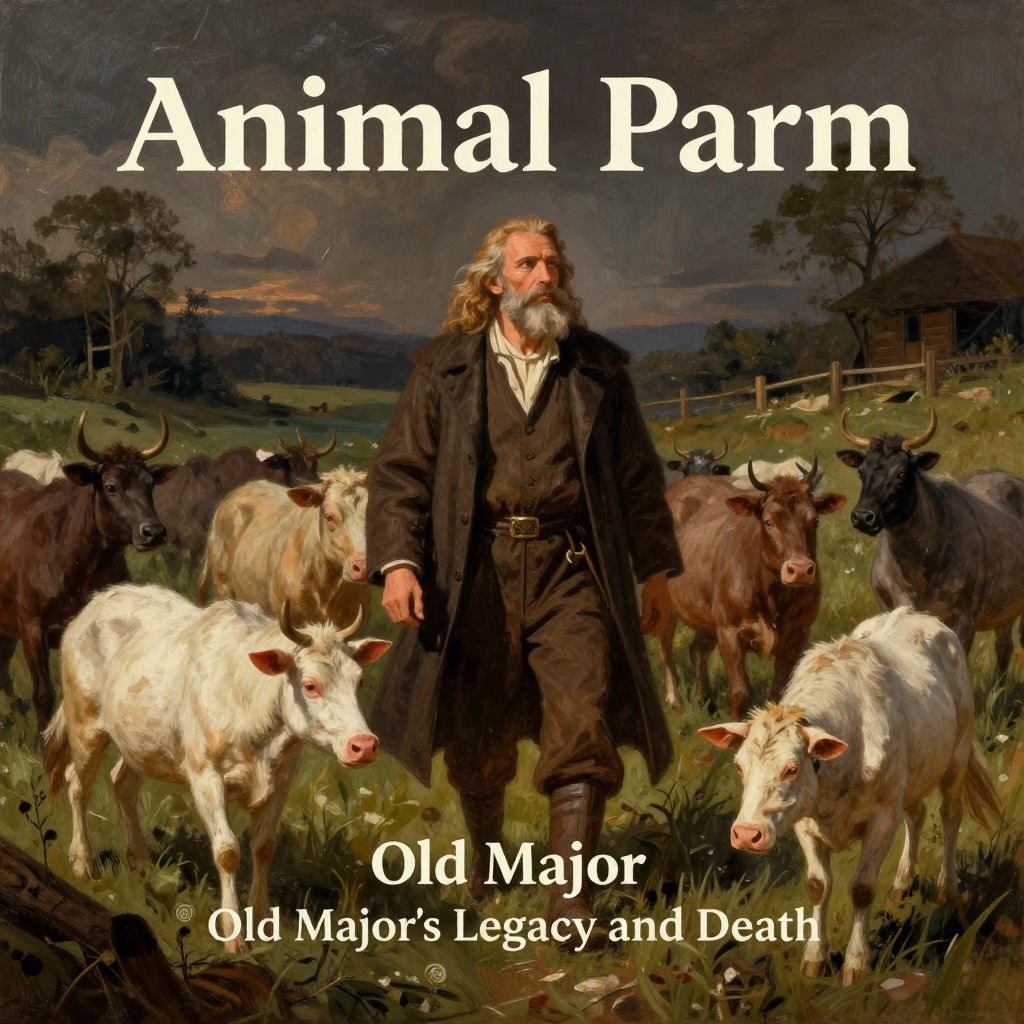
The Big Barn first appears as the designated meeting place for Old Major's address, the event that ignites the spirit of rebellion. It is agreed that all animals will gather there "as soon as Mr. Jones was safely out of the way." Inside, Old Major is already "ensconced on his bed of straw, under a lantern which hung from a beam" on a raised platform at one end. The barn's interior accommodates the diverse animal population: the pigs settle in the straw before the platform, hens perch on window-sills, pigeons flutter to the rafters, and the horses, Boxer and Clover, lie down with care not to trample smaller creatures. This scene establishes the barn as a space of unity and shared purpose, where the animals listen to Major's prophecy of rebellion and learn the revolutionary anthem "Beasts of England." The singing of the song throws the animals into "wildest excitement," and they sing it five times in succession before being interrupted by Mr. Jones's gunshot. The barn is thus consecrated as the birthplace of Animalism.
The Seat of Government and the Seven Commandments
After the Rebellion, the Big Barn becomes the site of the farm's weekly government. Every Sunday morning, after the hoisting of the green flag, all animals troop into the barn for a general assembly known as the Meeting. Here, the work of the coming week is planned, resolutions are put forward and debated, and the pigs—always the ones to propose resolutions—lead the discussion. The barn's end wall is transformed into a permanent legal and ideological monument: Snowball, balancing on a ladder, inscribes the Seven Commandments in "great white letters that could be read thirty yards away." Above these, in even larger letters, he later paints the maxim "Four legs good, two legs bad." The barn thus houses the farm's constitution and its simplified slogan, making it the physical repository of the revolution's laws. The Meetings always end with the singing of "Beasts of England," reinforcing the barn's role as the heart of communal ritual.
The Scene of the Coup and the End of Debate
The Big Barn is the stage for the most dramatic rupture in the farm's political life: the expulsion of Snowball. During a crucial Sunday Meeting, as Snowball delivers a passionate speech advocating for the windmill, Napoleon stands up, utters a high-pitched whimper, and nine enormous dogs—the puppies he had secretly raised—bound into the barn and chase Snowball out of the farm forever. In the same barn, immediately after the chase, Napoleon mounts the raised platform where Old Major had once stood and announces the abolition of the Sunday-morning Meetings. From now on, all questions will be settled by a special committee of pigs, presided over by himself. The barn, once a forum for debate, is now a place for the mere reception of orders. When four young porkers squeal in protest, the dogs growl them into silence, and the sheep drown out all discussion with a prolonged bleating of "Four legs good, two legs bad." The barn's transformation from a democratic assembly hall to a theater of authoritarian command is complete.
A Space of Ritual, Confession, and Terror
Under Napoleon's rule, the Big Barn becomes the setting for increasingly orchestrated rituals and brutal purges. Every Sunday morning at ten o'clock, the animals assemble to receive their orders for the week, filing past the skull of Old Major—now set up on a stump at the foot of the flagstaff—before entering. Inside, Napoleon, Squealer, and the poet Minimus sit on the raised platform, surrounded by the nine young dogs in a semicircle, while the other pigs sit behind and the rest of the animals face them. The barn is also the site of the mass executions following the purge. Napoleon, wearing both his medals and surrounded by his dogs, calls the animals together in the yard, but the confessions and killings begin after the animals have been assembled. The barn's floor, once covered with Snowball's chalk plans for the windmill, is now the place where animals are dragged before Napoleon to confess their crimes before being torn apart by the dogs. The air, once filled with the singing of "Beasts of England," becomes heavy with the smell of blood. Later, the barn's wall is altered: the poem "Comrade Napoleon" is inscribed at the opposite end from the Seven Commandments, surmounted by a portrait of Napoleon in white paint. The barn thus becomes a monument to the cult of personality, its walls bearing both the original laws and the new propaganda.
The Final Erasure
In the novel's closing scene, the Big Barn is the site of the ultimate revelation. After the pigs begin walking on their hind legs, Clover leads Benjamin to the end wall where the Seven Commandments are written. Benjamin reads out what is now the only remaining commandment: "ALL ANIMALS ARE EQUAL BUT SOME ANIMALS ARE MORE EQUAL THAN OTHERS." The barn's wall, which once held the unalterable law of Animalism, now displays a single, self-contradictory maxim that legitimizes the pigs' complete domination. The barn, which began as the space of revolutionary hope and collective decision-making, ends as the silent witness to the revolution's total perversion, its walls holding the final, cynical truth of the new order.